The So-Called “Jet Black Cockatiel”
The So-Called “Jet Black Cockatiel” – An Educated Perspective 📚
Long read ahead, so grab a cup of tea and take your time with this one.
A video (as to my knowledge first shared on TikTok by the user credited in the watermark, which is currently being discussed) recently went viral across social media platforms, claiming to have produced a Cockatiel chick that is almost entirely jet-black. The video claims the bird is “original”, suggesting a new or unique mutation. However, as I’ll explain, this appearance is likely artificial and not a result of natural genetics. While new mutations can occur, they require consistent breeding outcomes and genetic testing to be verified. A single viral video lacking parental history and displaying clear inconsistencies fails to meet this standard. As someone deeply involved in Cockatiel breeding and familiar with their genetics, I feel it necessary to address this widely circulated content with a fact-based explanation for the benefit of both serious breeders and newcomers in the avicultural community.
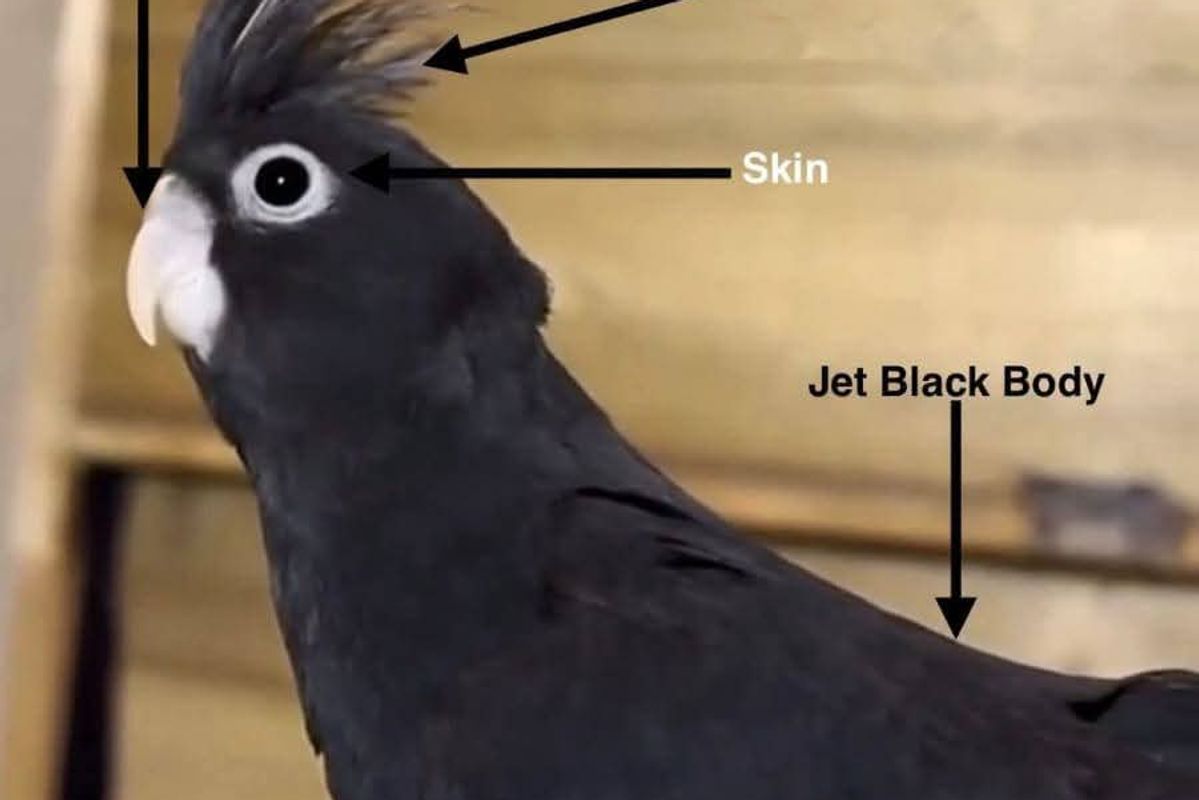
At first glance, the bird may appear unusually dark, but upon closer observation, certain telltale signs suggest that this is not a naturally occurring mutation. The chick’s beak, feet, and nails all appear significantly lighter, more in line with the usual pink or flesh-coloured tones seen in most Cockatiel mutations, as can be seen in screenshot. In a truly melanistic bird, one would expect heavy melanin expression not only in the feathers but also in the skin, beak, and nails, which is clearly absent here, as marked in screenshot. Furthermore, there is visible tonal inconsistency in the outermost lateral rectrices (outer tail feathers), which typically results from either uneven dyeing or poor digital editing, as pointed out in screenshot. In this particular screenshot, i.e., screenshot, the feet are darker (pigmented), and the beak and nose cap resemble those observed in Normal Greys (wild-types), not the flesh-coloured tones seen in screenshot. These inconsistencies indicate that there are more than one birds in the said video of different colour morphs Moreover, the shown bird(s) have either been dyed or the footage has been digitally manipulated using AI-based tools, filters, or colour enhancement.
As a Cockatiel breeder and someone familiar with avian pigmentation, I’ve chosen to evaluate the claim from a melanism perspective. While neither the video nor its source explicitly refers to the bird as melanistic (at least to my knowledge), if the footage were genuine and unaltered, melanism would be the most plausible biological explanation for such a dark appearance.
To understand why a “jet black Cockatiel” is not biologically or genetically possible (at least based on the long-established genetic history of Cockatiels), it is important to recognize how pigmentation works in this species. Cockatiels possess two major pigment systems which are;
1. Melanin:
This pigment is responsible for darker colors such as greys, blacks, and browns. It defines the typical coloration of feathers, eyes, beak, nails, and the skin (including the feet). Increased melanin expression can make feathers and body parts appear darker, and it plays a key role in sexual dimorphism, especially in males after their first molt.
2. Psittacofulvins (also known as psittacines):
These pigments are unique to parrots and produce the yellow, red, and orange coloration, prominently seen in the facial mask of adult males, the cheek patches in both sexes, and the undertail and underwing markings in females. These pigments are not structurally the same as melanin and cannot be replaced or overridden by it. They are controlled by entirely different genes and produced through separate biological pathways, meaning one cannot cancel out the other naturally. In fact, melanin and psittacofulvins often coexist within the same feather—melanin being deeper in the structure, and psittacofulvins expressed more on the surface. If psittacofulvins appear “missing,” it is usually due to a genetic mutation (such as in Whiteface), which suppresses their expression, not because of increased melanin.
When young, both genders exhibit equal amounts of visible expression of melanin and psittacofulvins, which makes males and females look almost alike up to the first molt. During the first molt, puberty hits, sex hormones take action, and start imparting gender differences to males and females. The females retain their juvenile coloration and remain almost unchanged, with suppressed psittacofulvins expression on the face, crest, underwing, and undertail spots and barrings. This sometimes makes the female appear melanistic, but as mentioned above, even the trace amounts of psittacofulvins being expressed in the coloration disqualify it from being truly melanistic. On the other hand, as puberty hits the young male Cockatiels, their chests and tails begin to darken, which is due to the increased melanin deposition. The tails of the males molt into a black colour with no barring. However, psittacofulvins come into play and produce a bright yellow facial mask and bright red/orange cheek patches, making a truly melanistic phenotype genetically unrealistic.
Moreover, in wild-type coloration, the skin, beak, feet, and nails of both genders are dark, and when they hatch, they have yellow down feathers. The down feather coloration is based on the psittacofulvins expression i.e., yellow for Normal birds (with red/orange cheek patches) and Yellowcheeks (YC), pale yellow for Pastelface (PF), white for Whitefaces (WF), and creamy for Creamfaces (CF), which is strong evidence that suggests a purely melanistic Cockatiel with complete saturation in the areas where melanin and psittacofulvins normally coexist is simply not possible.
No known Cockatiel mutation, whether naturally occurring or man-made (through selective breeding or molecular manipulation), is capable of eliminating psittacofulvins entirely and saturating melanin to a degree that would result in a fully black appearance across all visible features (skin, beak, eyes, and nails). Even the dark-marked wild-type (the Normal Grey) and mutations like Dominant Silver (DS), which are known for darker skin tones, still display contrast and never show full melanin saturation across the entire body, skin, and appendages (DS is a dilute mutation that reduces melanin distribution in the body, but still imparts a darker skin tone and mentioned here only to highlight skin tones).
At one end of the pigmentation spectrum, we have the Whiteface (Whiteface Grey, a.k.a Charcoal) mutation, which suppresses psittacofulvins. This results in a bird that resembles the Normal Grey but lacks the characteristic yellow and red/orange hues on the face, wing bars, and tail. What’s happening here is not the complete elimination of psittacofulvins, but rather a genetic suppression that replaces those colors with what appears white to the human eye. The genes for psittacofulvins are still present, just not expressed phenotypically. The appearance of white instead of yellow and red/orange is due to structural coloration, which is basically the change in the microstructure of the feathers that reflects ambient light in such a way as to give off the white appearance.
Taking it a step further, on the opposite end of the spectrum, the Whiteface Lutino (often incorrectly referred to as “Albino”) lacks both melanin and psittacofulvins, producing an all-white bird with red eyes and a lighter (pinkish) tone in skin, beak, feet, and nails. However, this represents pigment removal or reduction, not intensification of just one of the pigments while eliminating the others. The concept of achieving a uniform “jet black” phenotype through natural mutation in Cockatiels remains genetically unsupported and, thus, practically unachievable.
It is also important to note that even the top-notch Cockatiel mutation breeders, who have spent decades working with known and experimental lines, have not been able to produce a bird even remotely close to the one seen in the viral clip. This alone should serve as a major indicator that what we’re seeing is not the result of genetics, but rather manipulation.
What we are likely seeing in the viral video is a combination of editing and visual manipulation. The footage may have been deliberately altered/filtered or the bird could have been artificially dyed — a practice that is unfortunately sometimes used for viral attention and fame, despite being unethical and potentially harmful to the bird.
To further support this, I carefully reviewed the video and captured several screenshots, highlighting key inconsistencies. One notable observation is that the chick appears to be only about two to three days old, yet shows unusually dark down feathers. However, the left tiny wing, particularly the shoulder or flight area highlighted in screenshot 1, clearly lacks the same level of darkness and is neither black nor even dark enough to indicate true melanism. This pale patch is a major red flag.
Melanism is not limited to feathers, differences, marked and pointed out in screenshot. It is a genetic condition involving the overproduction of melanin in multiple tissues, including the skin, beak, feet, claws, feathers, and even the eyes. In truly melanistic birds, the skin and all other pigmented areas are expected to appear darker from hatching. The inconsistency in pigmentation shown in the video directly contradicts what would be expected in a genetically melanistic chick. These observations have been annotated and will be visible in the screenshots provided below as evidence
It’s important that we, as responsible breeders and enthusiasts, avoid falling for such exaggerated claims. Promoting or spreading such misinformation not only misguides new hobbyists but also undermines the integrity of those working sincerely to improve and develop this species through ethical breeding practices. Breeding should be rooted in understanding, genetics, and standard-based evaluation, not viral trends or aesthetic illusions.
I’m sharing this clarification to promote awareness and to help members identify what’s real and what’s not. Always question what you see online, especially when it seems “too unique” to be true, because in aviculture, consistency and science speak louder than spectacle.
Courtesy: #Ali Warraich Bhai.
Lahore, Pakistan 🇵🇰