Selective Breeding in Cockatiels
*Selective Breeding in Cockatiels*
Understanding Generations, Inbreeding, Linebreeding & Crossbreeding
Cockatiel breeding is not simply about pairing two beautiful birds and waiting for attractive chicks. A well-planned breeding program is based on *selective breeding, proper genetic understanding, careful pairing and accurate record keeping* .
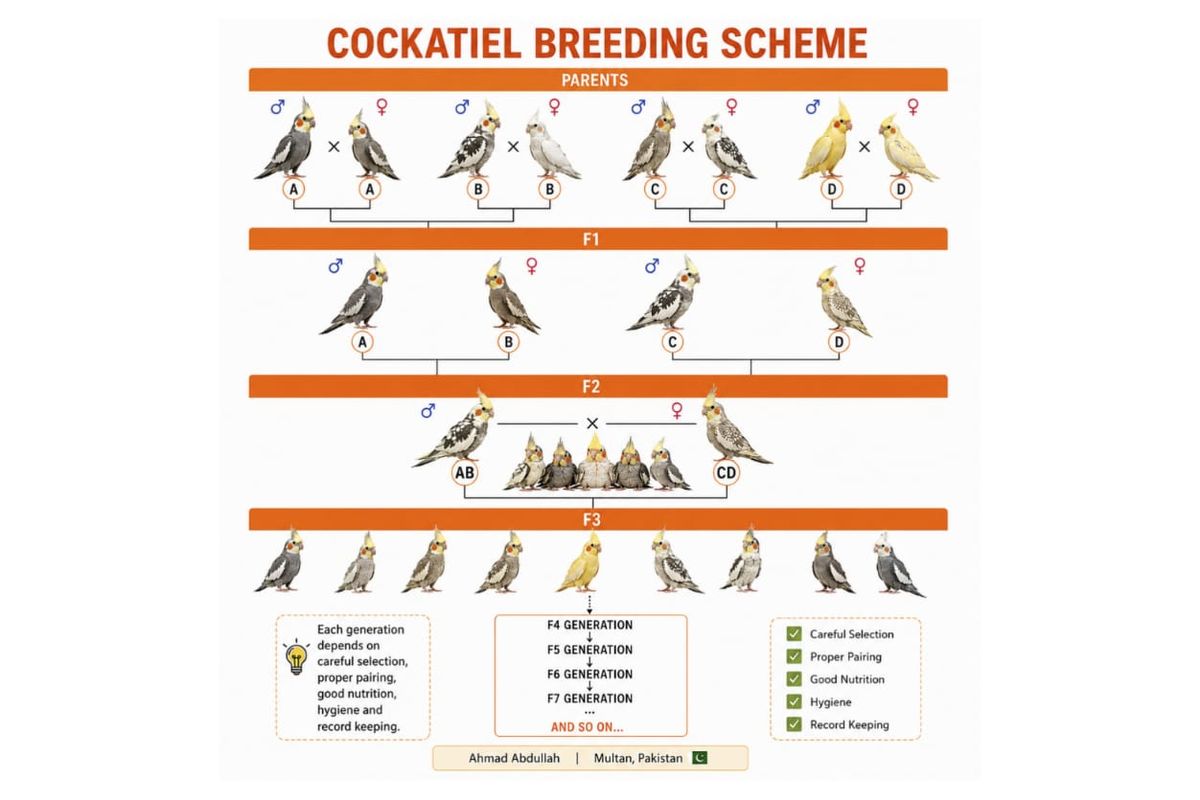
A breeder may work with different generations— *P, F1, F2, F3 and beyond* —while gradually selecting birds that carry the desired qualities.
*Understanding P, F1, F2 & Later Generations:-*
*P Generation* (Parental Generation):
The original male and female selected for a breeding program.
*F1 Generation* (First Filial Generation):
The direct offspring produced from the P generation.
*F2 Generation* (Second Filial Generation):
The offspring produced from the F1 generation.
*F3 Generation*
The next generation produced from F2, with the same sequence continuing through F4, F5, F6 and F7.
The important point is that *a higher generation number does not automatically mean a better bird* . The quality of each generation depends on the birds selected, their genetics, health and the objectives of the breeding program.
*Why Do Breeders Use Selective Breeding?*
Selective breeding means choosing particular birds for breeding because they possess desirable characteristics.
Breeders may use it to:
Produce higher-quality birds
Establish or maintain desirable mutations and traits
Improve body structure, feather quality, size and appearance
Develop more consistent bloodlines
Produce more predictable results over generations
Develop birds with greater breeding value and market demand
The purpose should not be to produce a particular colour at any cost. *Health, structure, temperament and genetic quality should remain part of the selection process* .
*Benefits of Selective Breeding* :-
When properly managed, selective breeding can help a breeder gradually improve a bloodline.
It can result in:
*Better quality → Stronger selection → More consistent traits → More predictable breeding results*
It can also help a breeder understand which birds consistently pass desirable characteristics to their offspring.
However, selective breeding requires patience. Genetic improvement normally takes multiple generations rather than happening in a single breeding season.
*Inbreeding — Close-Relative Breeding*
*Inbreeding* involves breeding closely related birds, such as:
*Father × Daughter*
*Mother × Son*
*Brother × Sister*
Breeders may use close breeding to increase the chance of retaining or expressing particular genetic traits.
However, repeated or poorly managed inbreeding can increase homozygosity and also increase the chance that harmful recessive variants become expressed. It may therefore be associated with problems such as *reduced fertility, weaker offspring and reduced overall genetic diversity* .
For this reason, close inbreeding should never be performed simply because two birds have desirable colours.
*Linebreeding*
*Linebreeding* is a more controlled form of breeding related birds.
The objective is generally to maintain desirable characteristics from a particular family or bloodline while avoiding the closest possible relationships.
A breeder may therefore work within a family line but introduce birds with a greater degree of genetic distance when necessary.
*The goal is to preserve good qualities without unnecessarily narrowing the genetic base* .
*Crossbreeding / Outcrossing*
*Outcrossing* means pairing birds from different bloodlines.
For example:
*Bloodline A × Bloodline B → Offspring*
This can introduce new genetic variation into a breeding program and can be useful when a line has become too closely related.
Outcrossing may also provide the breeder with new combinations of genes from which future selections can be made.
However, bringing in a new bloodline does not automatically make the offspring better. *The quality of the introduced birds still matters* .
*The Risks of Poorly Planned Breeding*
Breeding only for colour or appearance can create problems.
A breeder may unintentionally:
Increase genetic relatedness
Concentrate undesirable traits
Reduce genetic diversity
Overlook poor structure or feather quality
Select birds with weak health simply because they have a desirable mutation
Therefore, colour should never be the only criterion for selecting a breeding bird.
*The Real Goal of a Breeding Program*
A successful Cockatiel breeding program should aim for:
*Good Health + Strong Structure + Quality Feathers + Good Temperament + Desirable Genetics + Proper Bloodlines*
Every generation should be evaluated carefully, and breeding records should be maintained.
A good breeder is not the person who simply reaches *F7* .
*A good breeder is the one who improves the quality of the bloodline while maintaining the health and welfare of the birds.*
*Final Thought*
Selective breeding is a long-term process. *Inbreeding, linebreeding and outcrossing are tools—not goals in themselves* .
The real skill of a breeder lies in knowing *when to use each approach, which birds to select, and when to introduce new blood* .
*Breed with a plan. Select with purpose. Maintain genetic diversity. Record every generation* .
Ahmad Abdullah
Multan, Pakistan 🇵🇰