Recombination Frequency Between the Sex-Linked Yellow Cheek Locus and Other Sex-Linked Mutations (Cinnamon, Ino, and Opaline) in the Cockatiel (Nymphicus hollandicus)
Recombination Frequency Between the Sex-Linked Yellow Cheek Locus and Other Sex-Linked Mutations (Cinnamon, Ino, and Opaline) in the Cockatiel (Nymphicus hollandicus)
Introduction
The sex-linked Yellow Cheek mutation is, to date, unique to the cockatiel (Nymphicus hollandicus). No other sex-linked mutation affecting psittacin pigmentation has been reported in any other parrot species. In Yellow Cheek birds, the orange cheek patch is replaced by a clear yellow patch, although a faint orange shadow may remain in some individuals. This suggests that the mutation acts somewhere within the biochemical pathway responsible for the production of orange or red psittacofulvins.
The Yellow Cheek mutation produces a brighter and cleaner yellow cheek patch than the dominant Yellowface mutation. Unlike Yellowface, the cheek patch does not develop the characteristic bright orange coloration as males mature.
Recombination, or crossing over, is the exchange of genetic material between homologous chromosomes during meiosis. When two genes are located on the same chromosome, they are said to be linked and are usually inherited together. However, if crossing over occurs between their loci, the genes may be separated and inherited in new combinations. The proportion of offspring inheriting these new combinations is known as the recombination frequency (RF). Recombination frequency is used to estimate the genetic distance between two loci, where an RF of 1% corresponds to one map unit, or one centimorgan (cM). Genes with low recombination frequencies are located close together on a chromosome, whereas genes with higher recombination frequencies are farther apart. The maximum observable recombination frequency is 50%, at which point the genes behave as though they assort independently, either because they are located on different chromosomes or because they are so widely separated on the same chromosome that crossing over occurs frequently between them.
A chromosome is a long DNA (deoxyribonucleic acid) molecule containing a linear arrangement of genes. Each gene occupies a specific position, or locus, on the chromosome and performs a unique biological function. Some genes encode proteins that directly influence traits, whereas others produce transcription factors that regulate the activity of many other genes and therefore function as master regulatory genes.
Most organisms possess two copies of each chromosome, one inherited from each parent, except for the sex chromosomes. In birds, males are ZZ, whereas females are ZW. Because the W chromosome is much smaller and contains relatively few genes, females possess only a single copy of most sex-linked genes located on the Z chromosome.
During meiosis, homologous chromosomes pair and exchange corresponding DNA segments through crossing over. This process reshuffles linked alleles into new genetic combinations, producing recombinant chromosomes and gametes. The probability of recombination between two loci increases with the physical distance separating them. By measuring recombination frequencies in large breeding populations, geneticists can estimate the relative positions of genes and construct linkage maps showing their order and approximate distances along a chromosome.
________________________________________
History of the Yellow Cheek Mutation in Egypt
The sex-linked Yellow Cheek mutation first appeared in Egypt on a limited scale during the second decade of the twenty-first century through a small number of imported birds. The mutation never became widely established, primarily because of its close resemblance to the Aqua mutation (known locally in Egypt as Pastel Face). In addition, many breeders believed that Yellow Cheek females exhibited poorer incubation and brooding performance.
At that time, nearly all imported Yellow Cheek birds also carried the sex-linked Cinnamon and Opaline mutations.
The initial breeding objective was to introduce the Ino mutation into the Yellow Cheek line, regardless of whether Cinnamon and Opaline were also present. رشوان, Sameh, Mohamed Abo Taim, followed later by Khalil, conducted numerous breeding trials in an attempt to achieve this objective. Despite these efforts, no successful case was recorded of introducing the Ino mutation into the Yellow Cheek line or of separating Cinnamon from Yellow Cheek.
Although the recombination frequencies between the Ino and Cinnamon loci had already been established, the chromosomal position of the Yellow Cheek locus relative to these genes remained unknown. After numerous breeding attempts, it became increasingly apparent that the Yellow Cheek locus was positioned very close to both the Ino and Cinnamon loci, indicating a very low recombination frequency.
Previously established recombination frequencies between the known sex-linked loci are:
• Zᶜⁱⁿ ↔ Zⁱⁿᵒ = 3 cM (3%)
• Zⁱⁿᵒ ↔ Zᵒᵖ = 30 cM (30%)
• Zᶜⁱⁿ ↔ Zᵒᵖ = 33 cM (33%)
After several unsuccessful breeding seasons, many breeders gradually lost hope. Each successive breeding attempt strengthened the belief that the Yellow Cheek locus was much closer to the other sex-linked loci than originally anticipated. Consequently, several breeders abandoned their breeding programs.
In recent years, however, Rashwan successfully demonstrated recombination between the Cinnamon and Yellow Cheek loci by producing a recombinant Yellow Cheek Pied female. During this breeding program, the observed recombination frequency between the Cinnamon and Opaline loci was close to one-third (approximately 33%), as expected from previous studies.
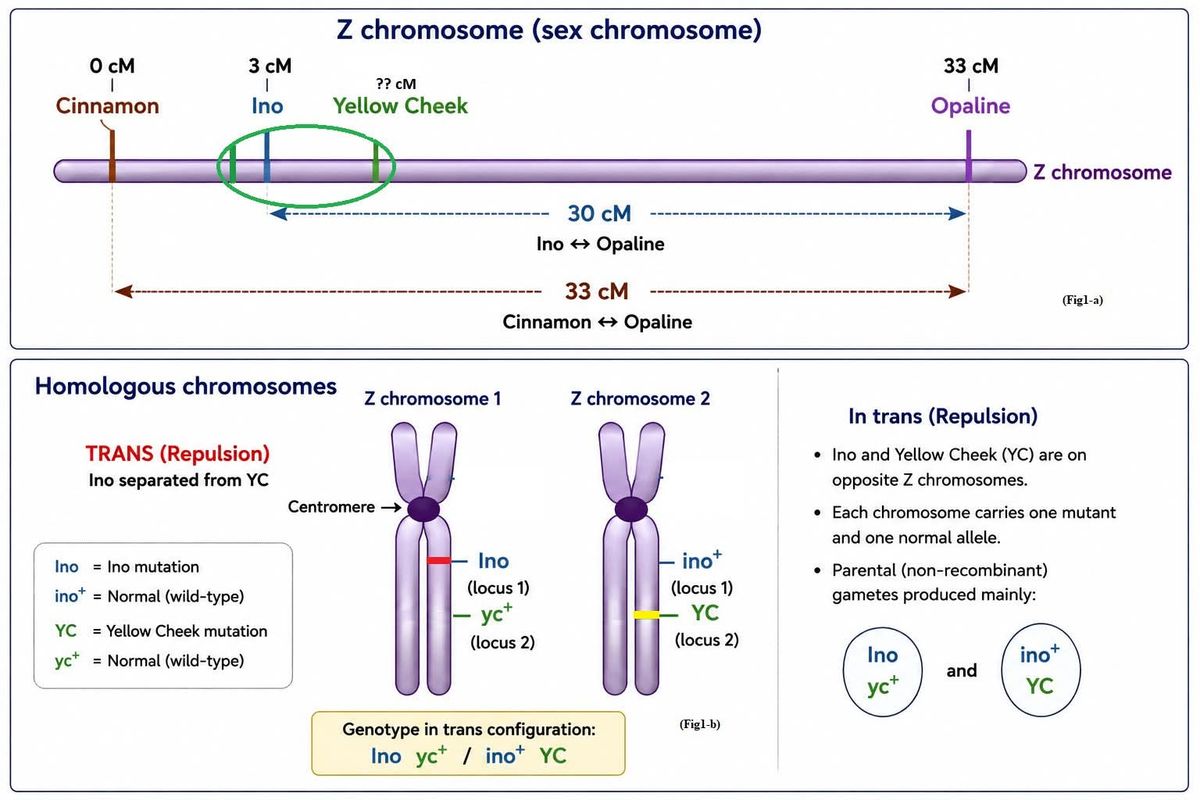
The breeding strategy followed the classical trans-to-cis approach. A male carrying the Ino and Yellow Cheek alleles in the trans configuration was first produced. Through meiotic crossing over, recombinant gametes were generated, eventually producing a female carrying both alleles in the cis configuration (Fig1-b).
After several breeding seasons, the accumulated breeding results suggested that the Yellow Cheek locus lies closer to the Ino locus than to the Cinnamon locus. (Fig1-a)
Although no precise records exist of the total number of breeding attempts undertaken over the years, the accumulated breeding evidence strongly suggests that the Yellow Cheek locus lies only a short genetic distance from the Ino locus.
At present, the exact chromosomal position of the Yellow Cheek locus remains unknown. Determining its precise location will require comprehensive linkage mapping using carefully designed breeding programs, combined with modern molecular genetic techniques such as whole-genome sequencing, molecular marker analysis, and cytogenetic studies. These approaches should ultimately allow the Yellow Cheek locus to be accurately positioned on the cockatiel linkage map and may identify the gene responsible for this unique mutation.
reference:A Guide to Cockatiels and their Mutations as Pet and viary Birds (Dr Terry Martin BVSc and Diana Andersen ABK Publications © 2007)
Courtesy
Yassin Tiel
Alexandria, Egypt 🇪🇬