
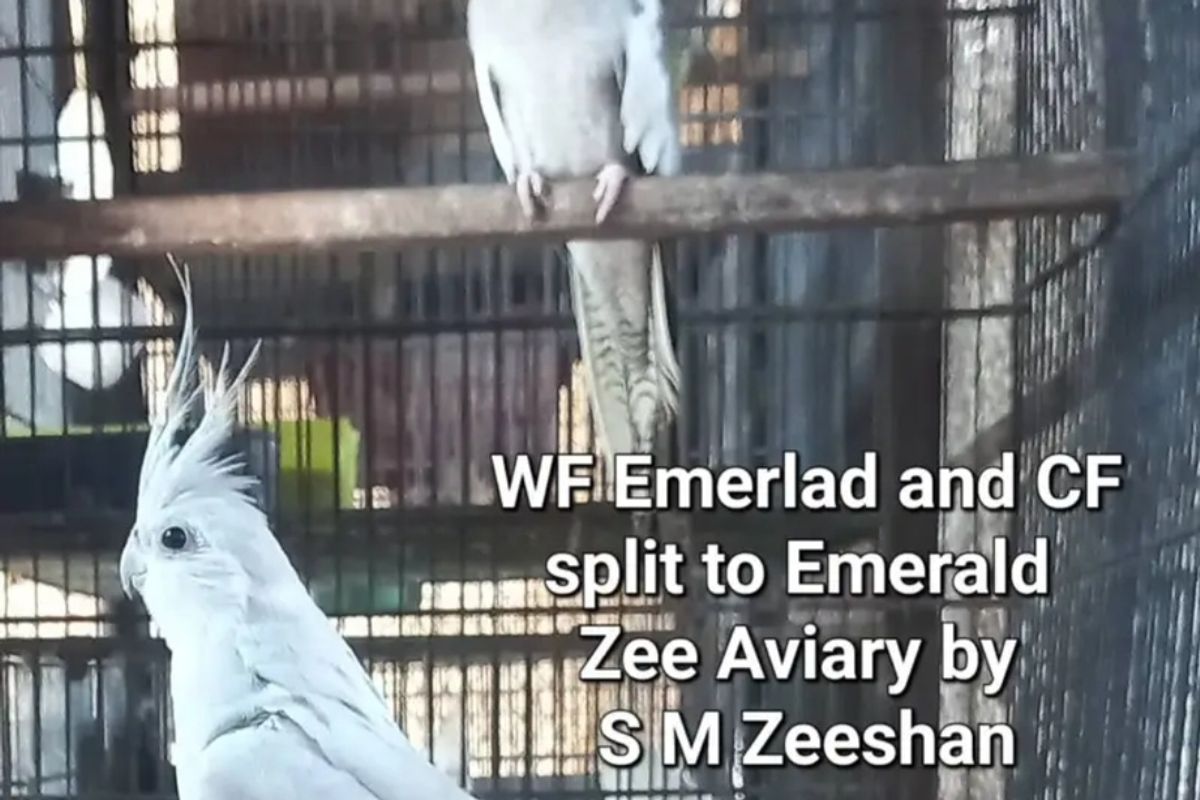
Emerald Cockatiels
Dear all, i want to discuss one thing about mutations on cocktails, i have observed that most of the time we keep on discussing about quality of bird in lutino n greys only. Mutations working should also be discussed and we should move forward in promoting and discussing mutation breeding.
To start with, i have a question about emeralds, how can we control colour pattern/ brightness in emeralds???
Exhibition Grade Birds refer to the birds which are capable of falling within the narrow range of the set standard. The Normal Grey is the real and true phenotype of Cockatiels, hence containing the strongest set of features, both genetic and physical. Therefore, Normal Greys are the easiest to work with and, most importantly, to develop the mutations. Being the initial mutations, Pied, Lutino, Opaline (Pearl), and Cinnamon are usually termed primary mutations/basic mutations and hence, many breeders have worked tirelessly to develop the specimens of these mutations. Due to the vast availability of good specimens of the Wild-Type and Primary mutations, most people tend to stick with these, so an intimidating impression of the good standardised breeding and bird-keeping may be showcased. Moreover, except Pied, the rest of the basic mutations have Sex-linked (“Z" a.k.a “X”, chromosome linked), which makes their production an easier task, and like-to-like pairings can be avoided, which are sometimes necessary for producing specimens of Autosomal Recessive mutations, but this combination deteriorates the features drastically.
However, to produce specimens of rare mutations, like Bronze Fallow, Creamface, Emerald etc, with at least reasonable features, a huge flock of Unrelated, Pure and Pure-bred Normal Greys is an essential, even an integral part. Secondly, every bird of this flock of Greys must either be capable of securing at least third position at the shows (where competition is quite tough) or be a very good producer whose babies are capable of such a goal. Without such Normal Greys, the development of any rare mutation, particularly of Autosomal Recessive Mode, is nearly impossible. So, the priority should be a flock of Greys that can really help down this long and exhausting journey.
As far as the question of Emerald’s colouration is concerned, first, understand how the emerald gene works. It reduces the melanin present in feathers in varying degrees, making the edges/boundaries of every feather clear and may give a darkened central touch, leaving yellow and white, which gives an overall greenish-yellow appearance when combined. It’s up to the breeder to choose how he likes his flock to appear and then carefully, selectively breed out the faults. I have heard from a breeder that he uses like-to-like pairings to control the appearance but he accepted that if he had Pure Greys, he wouldn’t have done that. It is because all the Greys in his locality have pied strain present in the gene pool. So, for any further development in rare mutations, very good, packaged and featured specimens of Normal Grey are required.
Note: I have given this statement of personal liking of colouration regarding emeralds because there is NO set standard for emerald colouration yet!
I would like to share some additional insights particularly regarding the challenges faced by this poor mutation.
There are several Cockatiel mutations that are bred in large numbers but still lag behind in development according to exhibition standards globally. Emerald is a prime example of this. The primary reason for the lack of quality in this mutation, particularly in terms of features like size, is the weak gene pool caused by excessive *inbreeding* during its early stages of development. Being one of the most commercially attractive mutations, the focus has unfortunately shifted toward maximizing profits rather than refining and improving its overall characteristics, including coloration, size, proportions, head features, and crest.
Another significant issue is that *exhibitors*, especially those already working on multiple mutations, often lack the capacity to add more mutations to their breeding programs. The mutations they usually work with are basic ones, which still require further development. Adding and developing a new mutation like Emerald demands more dedication, time, and resources that many breeders can’t afford to allocate.
Additionally, the reputation of the original line and the history of the birds play a crucial role. When a mutation lacks proper documentation or a reliable history, it becomes challenging for reputable breeders to trust its authenticity or invest in its development. No reputable breeder would take the risk of buying and working with a mutation that lacks such important information, doesn’t meet any specific standard, or comes with questionable origins.
In Pakistan, the situation with Emeralds is particularly disheartening. I don’t see a *single reputable stud here in Pakistan* with a long history of breeding that could serve as a reliable source for this mutation, allowing other breeders to confidently buy and work with Emeralds. Most of the Emeralds available locally seem to result from combinations involving Dominant Silver (DS). This is a major problem, as DS and Emerald are entirely different mutations, both genetically and visually. DS is a dominant gene, while Emerald is recessive. These two mutations cannot produce authentic Emeralds when combined. When such incorrect practices are common, how can a sensible breeder even consider purchasing Emeralds locally? Knowing that the birds are not bred according to the correct practices and standards or genetic principles undermines any confidence in the quality or authenticity of the mutation.
A critical foundation for developing and improving any mutation lies in the availability of quality pure Normal Grey Cockatiels that have a proper history. Pure Normals being the core provide a strong and diverse gene pool, which is essential for stabilizing and enhancing mutations. They bring balance to features such as size, structure, and overall health while reducing the risks associated with inbreeding. Without incorporating high-quality pure Normals into breeding programs, it becomes nearly impossible to achieve consistent improvement in mutations like poor Emerald. Reputable breeders worldwide understand this and often emphasize the importance of maintaining pure Normal Grey bloodlines in their aviaries.
Until these steps are taken, Emeralds will remain an underdeveloped and misunderstood mutation, lacking the recognition and status it could potentially achieve.
Courtesy: Emam Hashmi bhai #Ali Warraich bhai.
Lahore, Pakistan 🇵🇰